Voice search optimization: how to rank for “near me” spoken searches
Nobody says “dentist Dallas cheap” out loud. They say “find a dentist near me that is open now.” Voice search optimization is the work of making sure your business is the one the assistant names when it answers.
Key takeaways
- Voice searches are spoken questions, not typed keywords: full sentences, natural wording, and usually a place or a time attached.
- Most voice answers for local businesses come from the Google Business Profile, not the website, so the profile has to be complete and current.
- One spoken answer wins. There is no page two in voice, so the business that is clearest and closest usually gets named.
- Write answers in plain sentences that sound right read aloud: short, direct, and matching the exact question.
- Reviews, hours, and accurate categories decide more voice results than clever wording ever will.
- Measure voice performance through local rankings, calls, and direction requests, because no tool reports voice searches separately.

By Shamim, founder of Serpastra
Updated , 9 min read

Picture the moment: someone is driving, cooking, or walking the dog, and they ask their phone a question out loud. There is no screen full of blue links to browse. There is one answer, read aloud, and usually one business named. That is the whole game of voice search optimization. You are not trying to rank tenth. You are trying to be the single answer.
For a local business, this is good news. Voice questions are overwhelmingly local and immediate: where is the nearest, who is open now, how much does it cost, how do I get there. The business that answers those questions clearly, keeps its information accurate, and sits close to the person asking has a real chance to win. This guide explains how voice search works, what near me really means, and the practical steps that put your business in the answer.
How voice search actually works
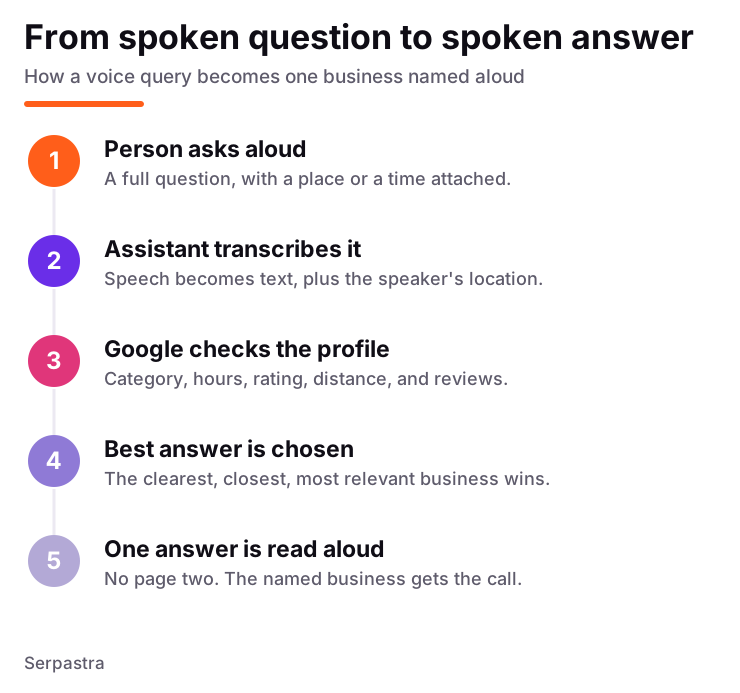
A voice search starts as sound, becomes text, and then becomes a normal search query with a few important differences. The assistant transcribes what was said, works out the intent, and usually adds the speaker's location, because most voice questions are about something nearby. Then it looks for an answer the same way Google always does: relevance, quality, and trust. The difference is in what it returns. Instead of ten links, it returns one spoken answer, sometimes with a short list on screen for the person to check.
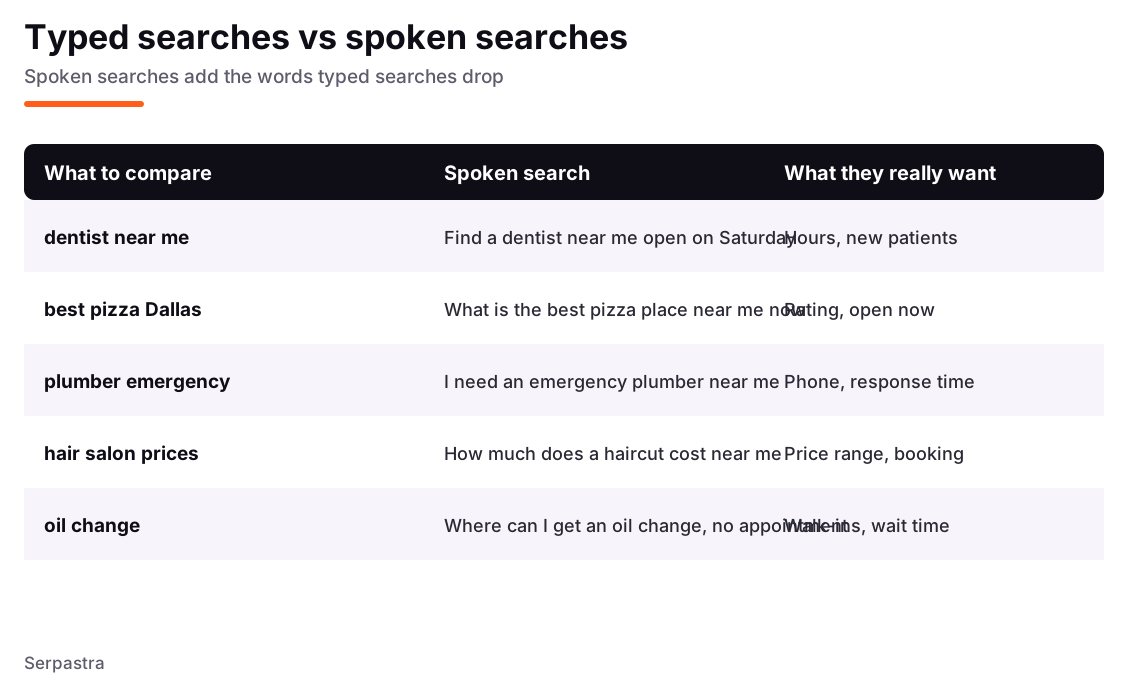
The questions themselves are different too. Typed searches are short and stripped down: "dentist Dallas", "pizza open now". Spoken searches are full sentences with natural grammar: "Where is a dentist near me that takes new patients?", "What pizza places are open right now near downtown?" They contain extra words that typed searches drop, especially question words, prepositions, and time phrases like "open now", "today", and "this weekend". Those extra words are the clues. They tell you exactly what the person wants, and your content should answer them in the same natural language.
What “near me” really means
Near me does not mean your city. It means near the person asking, right now. Google works out the location from the phone, and for local searches it can narrow results down to a neighbourhood, or even a few streets. A dentist who ranks first in their own neighbourhood can be invisible three miles away, because distance is one of the three factors Google uses to pick local results, alongside relevance and prominence.
This has two practical consequences. First, your service area matters more than your city. If you serve several neighbourhoods, your website and your profile should say so, in the words people actually use for those places. A page that says "serving the Dallas area" is weaker than pages that name the neighbourhoods, the landmarks, and the suburbs you actually travel to. Our guide to keyword research for local businesses covers how to find those place names.
| Typed search | Spoken search | What the person really wants |
|---|---|---|
| dentist near me | Find a dentist near me open on Saturday | Hours, location, new patients |
| best pizza Dallas | What is the best pizza place near me right now | Rating, distance, open now |
| plumber emergency | I need an emergency plumber near me | Phone number, response time |
| hair salon prices | How much does a haircut cost at a salon near me | Price range, booking link |
| oil change | Where can I get an oil change without an appointment | Walk-ins, wait time, price |
Your Google Business Profile is the answer
For local voice questions, the Google Business Profile is usually the source of the answer, not your website. When someone asks for the nearest open restaurant, the assistant reads the profile: the name, the category, the hours, the rating, the address, and the distance. If any of that is missing or wrong, the assistant picks someone else. This is why profile work is the first and most important step in voice search optimization.
Then keep it current. Hours that are wrong on a Sunday morning cost you the exact customers voice search would have sent. Photos matter too: a profile with recent photos of the real business gets chosen more often, and customers who arrive after a voice answer expect the place to look like the pictures. Our Google Business Profile checklist walks through every field, and our guide to ranking in the map pack covers the same signals voice uses, because they are largely the same list.
Not sure where to start?
Get a free audit - written findings in 2 business days, yours to keep.
Get my free auditThe website pages voice assistants read
The profile wins the simple questions. The website wins the questions that need an explanation: how much does it cost, what is included, do you treat this condition, can you fix this problem. For those, the assistant reads from web pages, and it prefers pages that answer one question clearly over pages that try to answer twenty.
Structured data helps the assistant find those facts. LocalBusiness schema on your homepage tells search engines your name, address, phone number, hours, and service area in a format machines read reliably. FAQ schema on question pages marks the question and the answer as a pair. Neither is a guarantee of a voice answer, but both remove guesswork, and removing guesswork is what optimization is. Our guide to schema markup for small businesses explains which types matter and how to add them without a developer.
Writing answers that get read aloud
Write the answer first, then the explanation. When someone asks "How much does a dental cleaning cost in Dallas?", the page should begin with a direct sentence: "A routine dental cleaning in our Dallas office costs between $99 and $150, depending on your situation." Then, below it, the detail: what is included, what insurance usually covers, and how to book. The assistant reads the first sentence. The person who taps through reads the rest.
This pattern is sometimes called answer-first writing, and it is the same pattern that wins Google AI Overviews and citations in ChatGPT, because all three systems want a clear, quotable answer. Keep answers short: one or two sentences, under about forty words, in plain language. Avoid jargon, avoid starting with "It depends" unless you immediately follow it with the actual answer, and avoid stuffing the sentence with keywords. A sentence written for a machine to read aloud should sound like something a person would say to a customer standing in front of them.
"Nobody talks to their phone in keywords. They talk in questions, and they expect a straight answer. The businesses that win voice search are the ones that give one." — Shamim, founder of Serpastra
Local content that matches spoken questions
Beyond service pages, a small amount of local content helps voice search, because spoken questions are often about the area, not just the business. A page that explains parking near your office, the neighbourhoods you serve, or how to find you from a well-known landmark answers the questions people ask on the way to you. A restaurant that writes about its lunch menu for the nearby offices answers a different question from a restaurant that only lists its dinner menu.
You do not need a blog the size of a newspaper. Three or four genuinely useful local pages, kept current, beat thirty thin ones. Tie each page to a service you actually sell, and link it to the service page, so a person who finds the local page can book in one click. Our internal linking guide shows how to connect these pages so they pass authority to the pages that take bookings.
Reviews and ratings in voice results
When the assistant has to choose one business from several nearby, reviews are often the tiebreaker. The rating matters, but so does the number of reviews, how recent they are, and whether the review text mentions the service the person asked about. A restaurant with forty recent reviews mentioning lunch is a stronger answer to "best lunch near me" than a restaurant with a slightly higher rating and three reviews from two years ago.
This is why the review request should be part of your routine, not a campaign you run once a year. Ask every customer, shortly after the visit, while the experience is fresh. Make it one tap. Reply to reviews, including the critical ones, in a calm and specific way, because the assistant and the customer both see the reply. And never write reviews for yourself, pay for them, or offer rewards for them: the platforms detect it, customers distrust it, and it can get a profile suspended. Our guide on whether Google reviews help SEO covers the mechanics in detail.
Measuring voice search without a voice report
No analytics tool has a voice search report, and none is coming soon, because a voice query looks like any other query once it reaches your site. So measure the things voice search drives instead. The Business Profile gives you calls, direction requests, and website visits. Your booking system gives you bookings. Your phone gives you calls. If those rise after you fix the profile and the service pages, voice is working, even if you cannot draw a line from one query to one call.
Search Console helps in a different way. Look at the Queries report for the long, natural-language questions: the ones that start with where, how, what, and when. Those are the closest thing to a voice report you will get. If the number of those queries grows, and the pages they land on are your service pages, your answer-first writing is being found. For the full method, see our guide to tracking your Google ranking.
Also listen, literally. Ask new customers how they found you. A surprising number will say "I asked my phone" or "I asked Google". Write it down. Over a month, that tally is more useful than any dashboard, because it tells you whether the people walking through the door came from a screen or from a spoken answer.
Common voice search mistakes
The first mistake is optimizing for a smart speaker as if it were a website. A page that ranks well in typed search will usually do fine in voice, because the underlying ranking is the same. The businesses that fail at voice are usually the ones failing at local SEO in general: incomplete profiles, thin service pages, no reviews. Fix the foundations first.
The third mistake is hiding the practical facts. Prices buried in a PDF, hours only on a Facebook page, a phone number shown as an image instead of text: every one of these is a fact the assistant cannot read. Publish prices, hours, and contact details as plain text on your own website, and keep the profile in sync.
The fourth mistake is forgetting the phone call. A voice search often ends with "call them". If your phone goes unanswered, or the person who answers cannot book an appointment, the ranking was wasted. The last step of voice search optimization is not technical at all: it is a person, answering the phone, ready to help.
A voice search checklist for this month
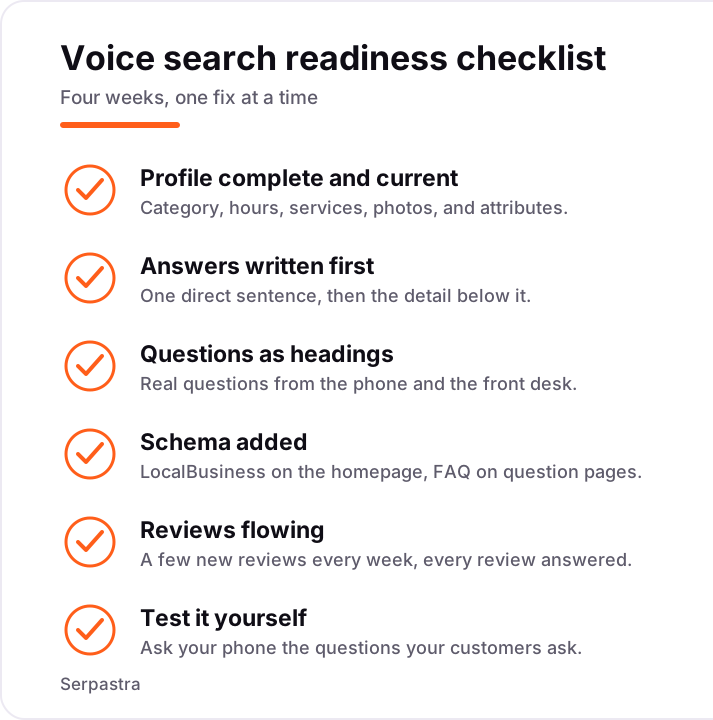
Week one: audit the profile. Check every field, fix the hours, add the missing services, and upload five recent photos of the real business. Ask three recent customers for reviews, and reply to every review from the last month.
Week two: pick your five most-asked questions, from the phone and the front desk, and make sure each one has a page or a section that answers it in one or two plain sentences. Put the question in the heading and the answer directly underneath.
Week three: add LocalBusiness schema to the homepage and FAQ schema to the question pages, and check that the name, address, and phone number match the profile exactly. One inconsistency, like a different phone number on the website, can cost you the answer.
Week four: test it yourself. Ask your phone the questions your customers ask, from a few different places in your service area, and note what it answers. If it names a competitor, look at what they publish that you do not, and fix that first. Voice search rewards the clearest answer, and clarity is something any small business can afford.
Sources we checked
These are the pages we actually consulted while writing this guide. Prices and plan details change often, so check the vendor page before you buy.
Related guides
 AI SearchWhat is AEO? Answer engine optimization vs SEOWhat answer engine optimization (AEO) is, how it differs from traditional SEO, and the practical steps that help your content get used in AI-generated answers.
 AI SearchHow to rank in Google AI Overviews: a practical guide for 2026How to rank in Google AI Overviews in 2026: what Google actually requires, query fan-out, answer-first pages, and how to track whether you are being cited.
 Local SEOHow to rank in the Google map packHow Google picks the three map pack results: relevance, distance and prominence explained, plus the practical steps that move a local business up the list.
Frequently asked questions
What is voice search optimization?
It is the work of making your business the answer a voice assistant gives when someone asks a spoken question. For local businesses that mostly means a complete Google Business Profile, clear service pages that answer real questions, and accurate hours, location, and review information.
Do I need different keywords for voice search?
You need different phrasing, not different keywords. Voice searches are full questions in natural language, such as where is the nearest pharmacy open now, instead of short typed phrases like pharmacy near me. Your pages should answer the full question in plain sentences.
Does voice search use my Google Business Profile?
Yes, for most local questions it is the main source. When someone asks for the nearest dentist or a restaurant open now, the assistant usually reads from business profiles, including the name, category, hours, rating, and distance. An incomplete profile rarely gets named.
Can a small business rank in voice search?
Yes, and small businesses have an advantage: voice answers are local and immediate, so the nearest relevant business with a complete profile and good reviews often wins over a bigger brand further away. You do not need to outrank national chains, only to be the clearest local answer.
How do I know if voice search is working for me?
There is no voice search report in any analytics tool. Watch the signals that voice drives instead: calls from your Business Profile, direction requests, and bookings that come from near me searches. If those rise while your local rankings hold, voice is doing its job.
Should I add FAQ schema for voice search?
FAQ pages help, because they give search engines clear question-and-answer pairs to read. But schema is a helper, not a guarantee: the page still has to answer the question well, and the business still has to be relevant and nearby. Add FAQ schema to pages that already answer real questions.
Shamim
Founder of Serpastra. A full-stack SEO and digital marketer who spends most days on Local SEO for dental practices, AI search visibility and lead generation. More about Shamim.