How long does it take to rank on Google in 2026?
Most SEO takes 3 to 6 months to show real movement, and 6 to 12 months for competitive terms. But that single number hides the useful part: some things move in weeks, and some terms take over a year.
Key takeaways
- Plan around ranges, not one number: local visibility can move in 2 to 8 weeks; competitive terms usually need 6 to 12 months.
- Only about 1.74% of newly published pages reached Google's top 10 within a year in a widely cited Ahrefs study - most target terms they cannot win quickly.
- Most of the time goes to crawling and indexing, Google testing the page, and earning trust - not to the work itself.
- Month 1 is fix-and-publish work; expect almost no rankings yet - impressions climbing is the first real signal.
- Start with the easiest winnable terms and fix technical problems before writing more content.
- Judge progress by leading indicators (impressions, average position, clicks) and by calls and bookings - not by tasks completed.

By Shamim, founder of Serpastra
Updated , 9 min read

How long does SEO take to rank? For most small businesses, the honest answer is 3 to 6 months before you see meaningful movement, and 6 to 12 months before competitive terms reach page one. Google itself has said to expect 4 months to a year for SEO to show results. That is not a stall tactic. It is how long crawling, indexing, comparison against existing pages and trust-building take.
But a single timeline is the wrong tool. A new dental practice in a small town and a five-year-old SaaS site chasing a national keyword are not doing the same job, and they should not expect the same wait. This guide gives you the timelines by situation, what actually takes the time, and how to tell — month by month — whether your SEO is working or just busy.
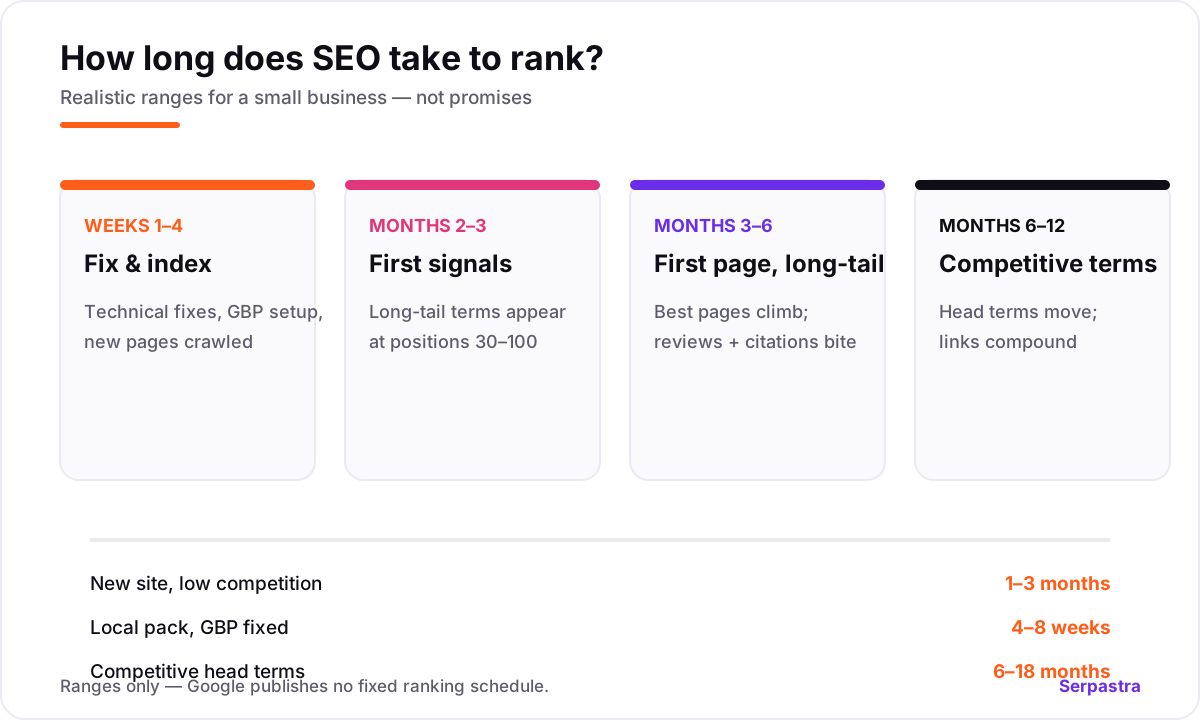
Realistic SEO timelines by phase. Treat them as planning ranges, not promises — Google publishes no fixed ranking schedule.
The short answer
If you want one number to plan around, use this: technical fixes and Google Business Profile work can move local visibility in 2 to 8 weeks; new pages on low-competition questions can rank in 1 to 3 months; competitive commercial terms usually need 6 to 12 months; head terms on a new site can take 12 to 24 months, or never arrive at all.
That spread is the point. Anyone who quotes you a single timeline without asking about your domain, your market and the keywords you want has not actually estimated anything. They have recited a slogan.
It also helps to separate three things people mix up. Indexing is Google finding and storing your page — days on an established site, weeks on a new one. Ranking is the page appearing for a query, often at position 40 or 80 first. Traffic is people actually clicking, which usually needs a top-10 position. A page can be indexed in a week, rank at position 55 in a month, and still send almost no traffic for six months. All three are progress, but only the last one pays.
What the data says
A widely cited Ahrefs study of new pages found that only about 1.74% of newly published pages reached Google's top 10 within a year, and that the average page ranking number one was about five years old. Read that carefully: it is not saying SEO fails 98% of the time. It is saying most new pages target terms they have no realistic chance of winning quickly, on sites with no track record for that topic.
The same study found that of the small group of pages that did reach the top 10 within a year, roughly 40% got there in the first month — usually on established domains, targeting a query the site already had authority for. The lesson is not to publish more. It is to pick fights you can win soon, and let the authority from those wins carry you into harder fights later.
That is also why local SEO moves faster than national SEO. A dentist fixing their Google Business Profile, earning a steady flow of reviews and publishing one strong service page per treatment is competing against a handful of practices in one city, not against every dental site on the internet. Our guide to how to rank in the Google map pack covers that faster track in detail — map pack movement in 4 to 8 weeks is realistic in a moderately competitive market, well ahead of the organic timeline for the same business.
Not sure where to start?
Get a free audit - written findings in 2 business days, yours to keep.
Get my free auditTimelines by situation
Use this table to find your situation, then plan around that row — not around someone else's case study.
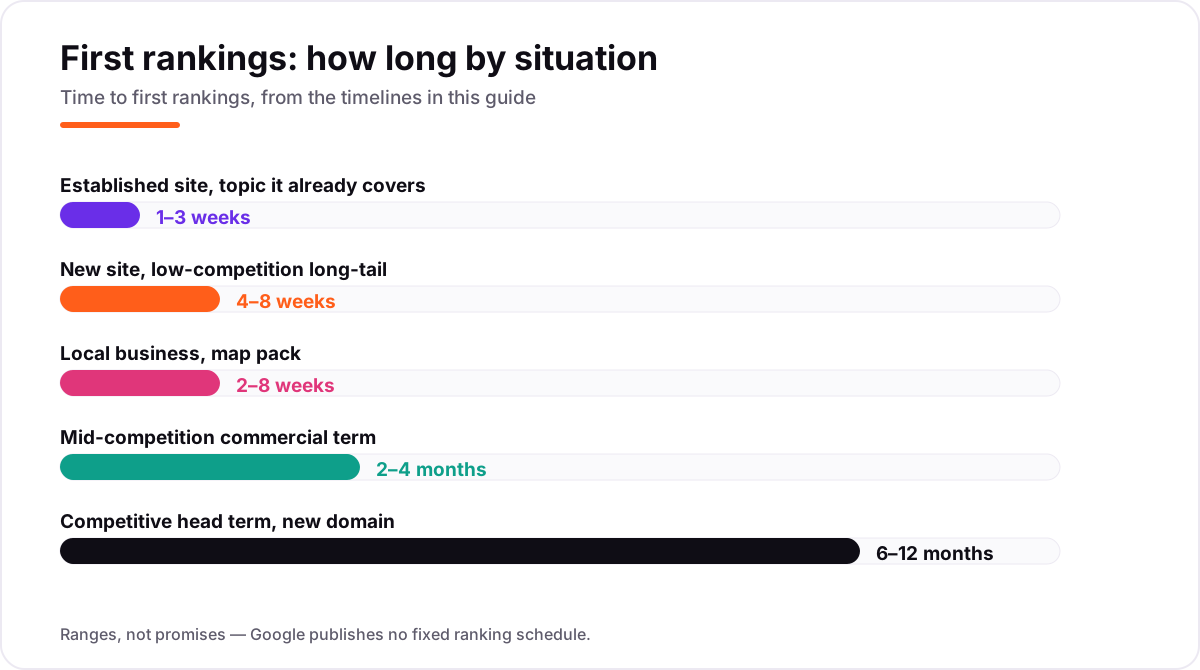
First rankings by situation — the ranges from this guide, not promises.
| Situation | First rankings | Meaningful traffic |
|---|---|---|
| New site, low-competition long-tail questions | 4–8 weeks | 3–6 months |
| Established site, new page on a topic it already covers | 1–3 weeks | 1–3 months |
| Local business, map pack + service pages | 2–8 weeks (map) | 3–6 months |
| Mid-competition commercial term | 2–4 months | 6–12 months |
| Competitive head term, new domain | 6–12 months | 12–24 months, or never |
| Site recovering from technical problems or a penalty | 3–6 months after fixes | 6–18 months |
Three things move you from the slow end of a row to the fast end: a technically clean site that Google can crawl without friction, content that answers the query better than the current top results, and links or mentions from sites Google already trusts in your field. Miss any one of those and the timeline stretches. A brilliant page on a site Google cannot crawl properly is invisible. A crawlable page with thin content gets a trial ranking and then slides back down.
What actually takes the time
SEO feels slow because most of the work is waiting on other systems. Here is where the months go.
Crawling and indexing
Google has to discover your page, crawl it, render it and decide it belongs in the index. On an established site with a clean sitemap and good internal links, that is days. On a new site, or a site with crawl problems — blocked resources, orphan pages with no internal links, a sitemap that lists pages that 404 — it can be weeks. Check this first in Google Search Console before assuming anything else is wrong. If the page is not indexed, nothing else matters yet.
The trial ranking
Once indexed, Google usually gives a new page a trial position — often somewhere on page three or four — and watches what happens. Do searchers click it? Do they stay, or bounce straight back to the results? That testing phase is why rankings often jump around in the first month. A page that appears at position 28 one week and 64 the next is not broken. It is being measured.
Trust and links
This is the slow part, and it cannot be rushed honestly. Links from relevant, real websites are still one of the strongest signals that a page deserves to rank, and earning them takes outreach, relationships and content worth linking to. Our guide to white-hat link building for local businesses explains what that work looks like in practice — and why bulk links bought for a flat fee usually do the opposite of what you paid for.
Topical authority works the same way. A site that has published ten solid pages on one subject earns the right to rank for the eleventh faster than a site publishing its first page on a brand-new topic. That is why a narrow content focus beats a scattered one in the first year: every page you publish makes the next one rank faster.
Competition does not stand still
Ranking is relative. You are not climbing a fixed ladder; you are racing pages that are also being updated, linked to and improved. A core update can move you up or down without you changing anything. That is normal, and it is why a timeline measured in weeks is a fantasy for anything competitive. Plan in quarters, judge in quarters, and fix the things you control in between.
Month by month: what to expect
Here is what a well-run campaign actually looks like, so you can tell whether yours is on track or stalled.
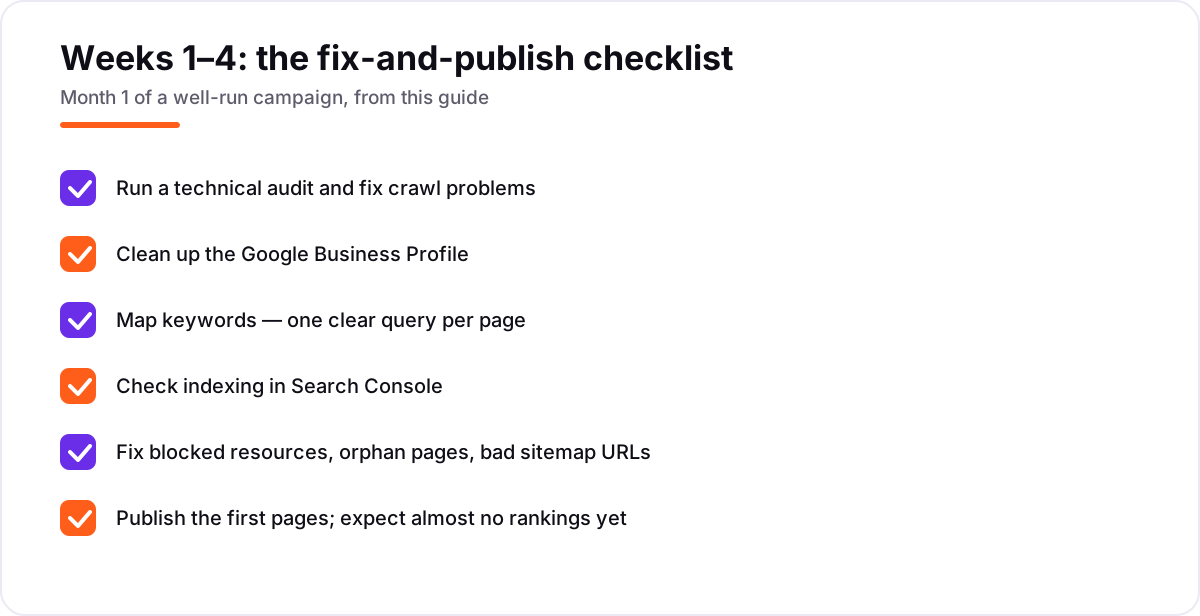
Month 1 is fix-and-publish work. Rankings come later; indexing comes first.
Month 1 — fix and publish. Technical audit and fixes, Google Business Profile cleanup, keyword mapping so every important page targets one clear query. In Search Console you should see pages getting indexed. In rankings, expect almost nothing. That is fine.
Months 2–3 — first signals. Long-tail pages start appearing at positions 30 to 100. Impressions in Search Console climb even if clicks do not. Map pack visibility moves first for local businesses. If nothing is indexed or appearing by the end of month 3, something is wrong — usually crawl access, thin content, or keywords far too competitive for the site's current authority.
Months 4–6 — the climb. The best pages reach page two and the bottom of page one for long-tail terms. A few commercial terms enter the top 20. This is when most businesses either quit too early or double down. The data at this stage — which pages are climbing, which queries bring impressions — tells you exactly what to write and link to next.
Months 7–12 — compounding. Pages published in month 2 now rank faster because the site has more authority. Commercial terms reach page one. Calls and form fills, not just rankings, should be moving. If rankings are up but leads are flat, the problem is usually the page itself — weak calls to action, no trust signals, or traffic from the wrong intent — not the SEO.
How to rank faster — honestly
There are no shortcuts that survive contact with Google. There are faster ways to do the honest work, though.
- Start with the easiest winnable terms. Use our keyword research process for local businesses to find questions your competitors answer badly. A page that ranks in six weeks teaches you more — and earns more links — than a page that sits at position 47 for a year.
- Fix technical problems before writing more. A slow site, broken internal links and duplicate pages tax every new page you publish. An audit first is cheaper than a year of content on a broken foundation. Our SEO audit is a one-time $349 project that lists fixes ranked by impact.
- Build one topic cluster at a time. Five connected pages on one subject beat five unrelated pages. Link them to each other with descriptive anchor text, and link them all to the service page that should convert.
- Earn links from the start. Partners, suppliers, local media, community work and genuinely useful content — the slow, real methods — beat any link package. One link from a relevant local news site is worth more than a hundred directory listings.
- Refresh, do not just publish. Pages that reached the top 10 and then slipped usually need a refresh — new data, better examples, clearer answers — not a replacement. Check your top 20 pages every quarter.
What does not work: buying links in bulk, publishing AI-generated pages by the hundred, keyword-stuffing, or paying for a “guaranteed page one in 30 days” offer. Google has seen all of it before, and the recovery time from a penalty is measured in months — longer than the honest timeline would have been in the first place.
How to tell if it is working
Judge SEO by leading indicators first, and by money second. In Search Console, track impressions, average position and clicks for the pages and queries you actually targeted — not for the site as a whole. In your business, track calls, form fills and booked appointments, and ask every new customer how they found you.
Red flags that the work is not working: no pages indexed after a month, no impressions growth after three months, rankings that only move for keywords nobody searches, or reports full of tasks completed with nothing about leads. If your provider cannot show you which pages moved and what that movement is worth, the problem is not the timeline. It is the work.
And if you are deciding whether to keep going, ask the question the other way round: what would it cost to stop? Rankings decay without maintenance. Competitors keep publishing. The businesses that win local search are rarely the ones with the biggest budget. They are the ones that kept going through months 4 to 6, when nothing looked impressive yet.
To judge progress you need clean tracking. Our guide to how to track Google rankings explains the setup, and our roundup of the best rank tracking tools in 2026 compares the tools that do it well.
What this costs, and where to start
Cost and time are linked: a bigger budget buys more content, more link work and faster fixes, which shortens the timeline — but it cannot buy a top ranking in a month for a competitive term. Our guide to how much SEO costs in 2026 breaks down the pricing models and what drives them. For reference, Serpastra's audit is $349 one-time, Local SEO starts at $450 a month, AI search optimization at $600 a month, and monthly SEO management at $700 a month, month to month after the first 90 days.
If you do not know what is holding your site back, start with the audit rather than a monthly commitment. It tells you whether your timeline problem is technical, content, links or keyword choice — and which of those to fix first. Book a free audit and we will look at your market and tell you plainly what a realistic timeline looks like for your business, and which plan fits it.
Related guides
 Pricing & HiringHow much does SEO cost in 2026? A plain pricing guideWhat SEO costs in 2026, how hourly, project, retainer and performance pricing work, what drives the price up or down, and how to set a budget that holds up.
 StrategyHow to track your Google ranking in 2026Track your Google ranking the right way: Search Console, free checkers and rank trackers explained, and what average position and CTR really mean today.
 On-PageKeyword research for local businesses, step by stepA practical, step-by-step keyword research process for local businesses: find what customers search, map terms to pages, and skip vanity keywords.
Frequently asked questions
How long does SEO take to rank on Google?
For most small businesses, 3 to 6 months for meaningful movement and 6 to 12 months for competitive terms. Technical fixes and Google Business Profile work can move local visibility in 2 to 8 weeks, while competitive head terms on a new site can take 12 to 24 months.
Can SEO work in 30 days?
Not for competitive terms. A page can be indexed in days and may appear for a low-competition long-tail query within a month, but page-one rankings for terms that bring customers take months. Anyone guaranteeing page one in 30 days is usually targeting keywords nobody searches, or using tactics that risk a penalty.
Why is my new website not ranking yet?
Usually one of three reasons: the pages are not indexed yet, the keywords are too competitive for a new domain with no link history, or the content does not answer the query better than the pages already ranking. Check indexing in Google Search Console first, then look at the competition for your target terms.
Does SEO take longer for a new domain?
Yes. A new domain has no link history and Google crawls it less often, so the same page can take 6 to 12 months to rank where an established site with topical authority might rank it in weeks. New sites do best by targeting specific, lower-competition questions first.
How do I know if my SEO is working?
Watch leading indicators in Google Search Console: impressions climbing, average position improving for the queries you targeted, and pages getting indexed. Then watch the business numbers: calls, form fills and booked appointments. If impressions are flat after three months, something in the work needs to change.
Should I stop SEO after 6 months if I am not on page one?
Not if the leading indicators are moving. Rankings compound — pages published in month 2 rank faster in month 8 because the site has more authority. Stopping usually means the gains decay while competitors keep going. Judge by the trend in impressions, positions and leads, not by a single keyword on a single day.
Shamim
Founder of Serpastra. A full-stack SEO and digital marketer who spends most days on Local SEO for dental practices, AI search visibility and lead generation. More about Shamim.