A 90-day SEO strategy template for a local business
Ninety days will not finish your SEO, but it will get the essentials in place in the right order. Copy this template and follow it week by week.
 Shamim, founder of SerpastraUpdated October 30, 20269 min read

Key takeaways
- Ninety days will not finish your SEO, but it will get the essentials in place in the right order.
- Before day 1, write down three things: your core services, your service area, and your conversion actions.
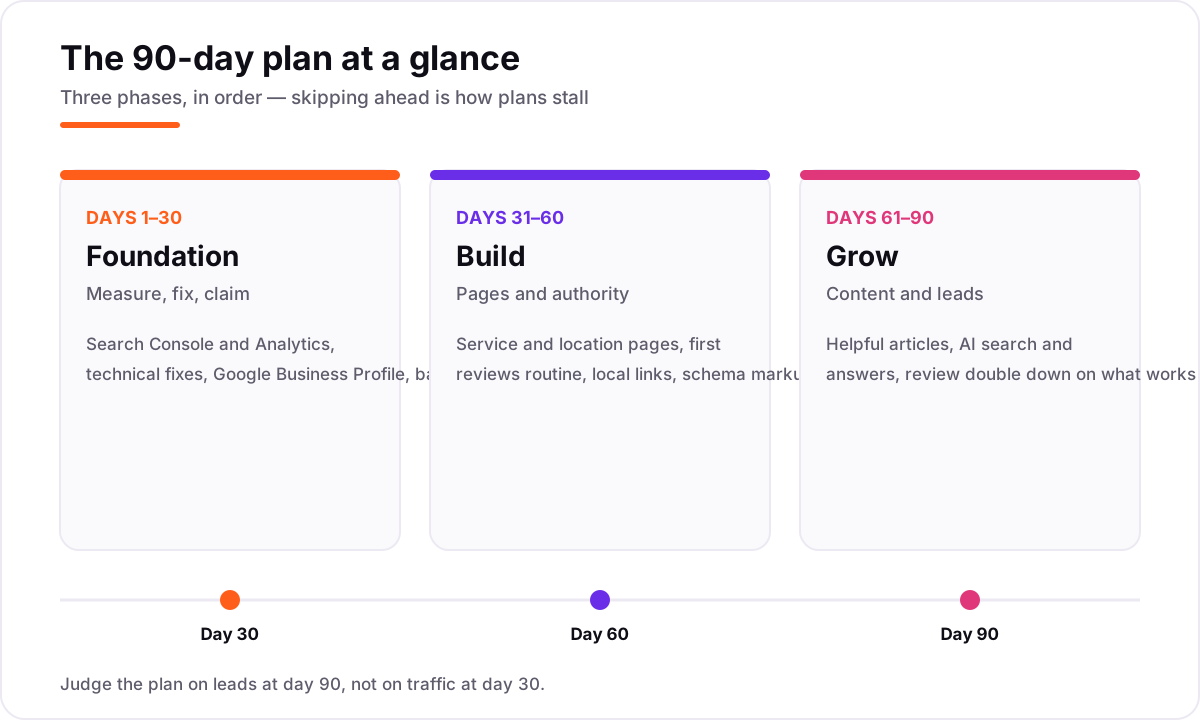
- Days 1 to 30 are foundation: measurement, fixes, and claiming what is already yours.
- Days 31 to 60 are build: service and location pages, plus the trust signals around them.
- Days 61 to 90 are grow: two useful articles answering real customer questions, plus conversion work.
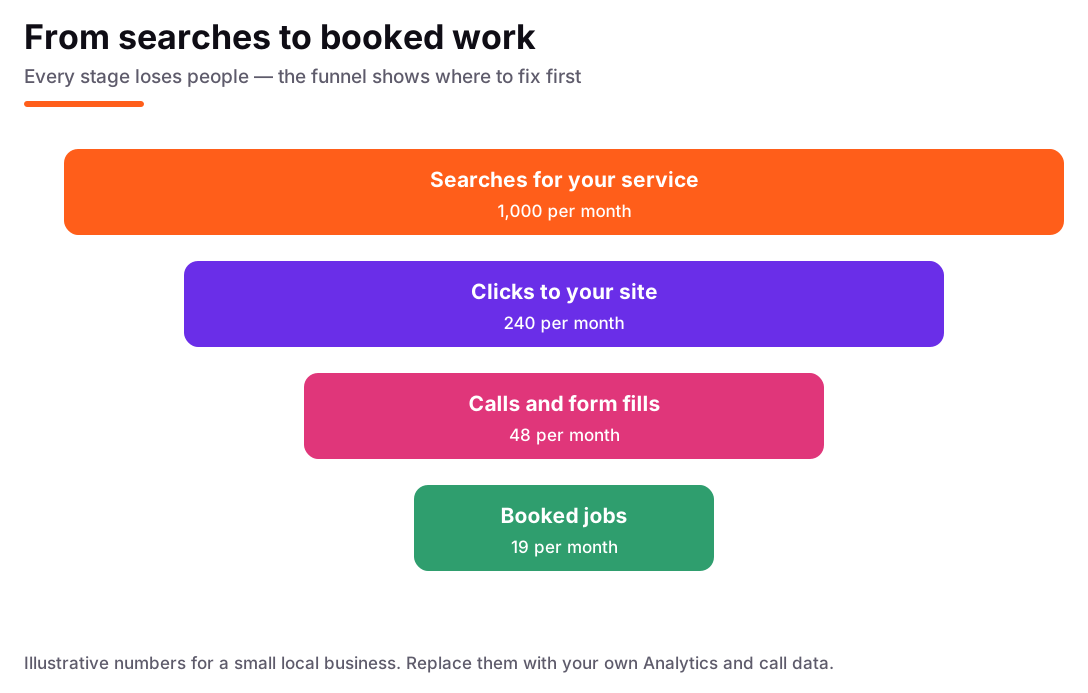
- Measure leads first, rankings second, traffic last — weekly, comparing four-week blocks rather than single days.
On this page
Ninety days will not finish your SEO. It will, however, get the essentials in place in the right order, and give you real data to steer by. That is the honest purpose of a 90-day plan: not to reach the top of Google in three months, but to build a foundation, publish the pages that matter, and learn what actually brings in customers before you spend more.
Most small business SEO plans fail for the same reason: they start with the wrong work. Blog posts before the Google Business Profile is finished. Link building before the service pages exist. This template runs the work in the order that makes each step easier than the one before it. Copy it, fill in the blanks, and follow it week by week.
Before day 1: decide what success looks like
Before you change anything, write down three things. Your core services: the three to six things that bring in most of your revenue. Your service area: the cities or neighbourhoods you actually want work from. And your conversion actions: calls, form submissions, bookings, direction requests, or purchases. Everything in the plan points back to these three lines. A plumber and a dental practice will follow the same three phases, but their pages, keywords and measurements will look completely different.
Then set one primary goal for the 90 days, in business terms. Not "rank number one", but "20 calls a month from organic search" or "12 new patient bookings a month from Google". Pick a number you can measure and a number that would make the effort worthwhile. How many calls and form fills come from search each month right now? That is your baseline, and everything else is measured against it.
Days 1 to 30: foundation
The first month is measurement, fixes and claiming what is already yours. It is the least glamorous phase and the one that matters most, because everything later is built on it.
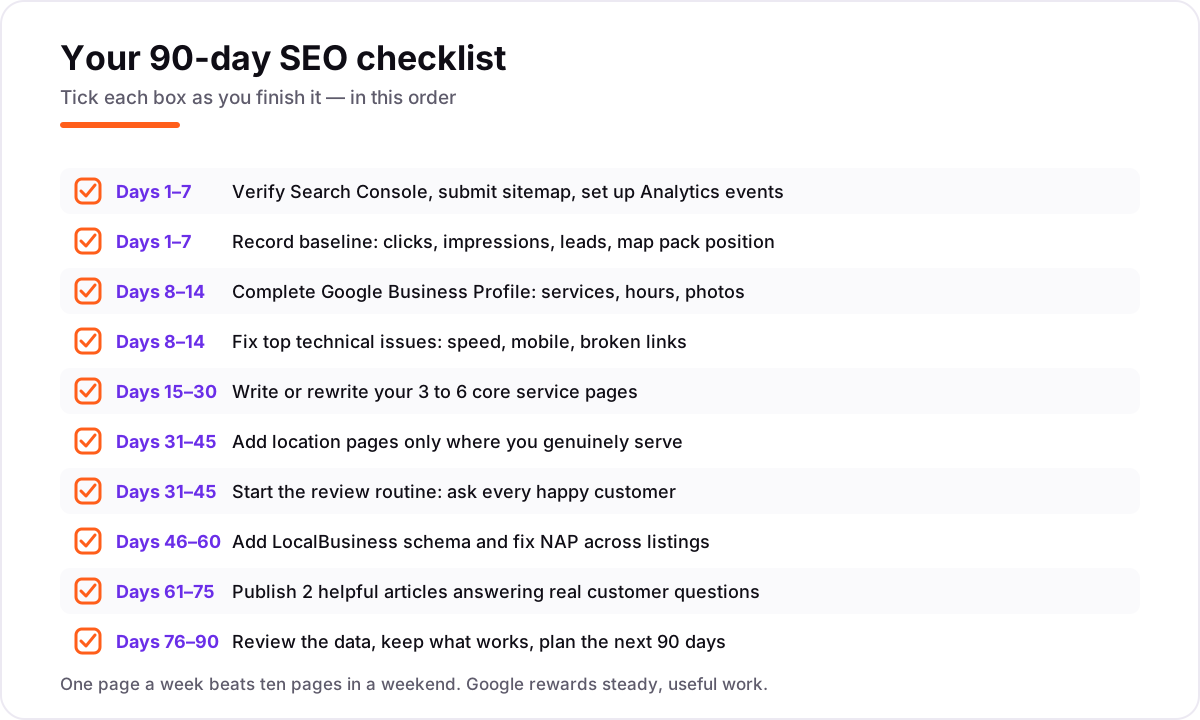
Week 1: set up measurement. Verify your site in Google Search Console and submit your XML sitemap. Add Bing Webmaster Tools, which you can import directly from Search Console. Confirm Google Analytics 4 is installed and set up key events for calls, form submissions and bookings. Then record your baseline: current clicks and impressions in Search Console, current leads per month, and which queries already bring traffic. Take screenshots. In 90 days you will want to prove the change, and memory is a poor record.
Week 2: claim and complete your Google Business Profile. Verify the profile if you have not, and make sure the business name matches your real-world name, with no added keywords. Fill in services, hours, service area or address, website link and a description. Add real photos of the business, the team and the work. Use our Google Business Profile checklist and work through it field by field. This single asset drives the map pack, and most local businesses have a half-finished one.
Weeks 3 to 4: fix the technical basics. Run a speed test on your homepage and main service pages, on mobile first. Fix broken links, missing page titles, duplicate titles and pages Google has indexed but should not have. Make sure your phone number is clickable on mobile and your contact form works. Then do keyword research for your business: find the terms customers type when they are ready to buy, map each one to a page, and note which pages do not exist yet. That list becomes the work of month two. Our guide to how long SEO takes to rank explains which fixes move fastest and why month one rarely shows ranking changes.
Not sure where to start?
Get a free audit — written findings in 2 business days, yours to keep. We will show you exactly what is holding your rankings back and what to fix first.
Days 31 to 60: build
Month two is where the site itself gets better. You know what you rank for, what is broken, and which pages are missing. Build those pages, and the trust signals around them.
Service and location pages. Write or rewrite your core service pages, one dedicated page per service, with real detail: what is included, who it is for, prices where you can, and the questions customers always ask. Add location pages only where you genuinely serve, and make each one genuinely different: a thin copy of the same page with a city name swapped in does more harm than good. Each page needs a clear call to action and a form that takes less than a minute.
Reviews routine. Start asking every happy customer for a Google review, the same day the work is done, with a direct link to the review form. Respond to every review, good or bad, within a day or two. Reviews feed local rankings and convert searchers comparing you with the business next door. Our guide to whether Google reviews help SEO explains what matters: recency and a steady flow, not a one-off burst.
Schema and citations. Add LocalBusiness schema markup so Google can read your name, address, phone, hours and services without guessing. Our schema markup guide for small businesses covers which types matter and how to test them. Then check your business listings across the main directories and fix any name, address or phone mismatches. Consistency matters more than volume: ten correct listings beat fifty sloppy ones.
First links. Before you chase links, run a competitor website analysis: look at who links to the businesses outranking you, and which of those links you could realistically earn. Local links are usually the easiest wins: suppliers, trade associations, local press, community sponsorships, and partners who already know your business. Our guide to white-hat link building for local businesses lists the approaches that work without buying links or joining schemes that Google penalises.
Days 61 to 90: grow
Month three is content and conversion. The foundation is in place, the pages exist, and now you publish the material that answers the questions buyers ask before they hire anyone.
Helpful articles, not blog filler. Publish two useful articles in this phase, chosen from real customer questions: pricing, how-to, comparison, and "what to expect" questions. Each one should answer the question properly, in the first few paragraphs, and link to the relevant service page. A guide for homeowners choosing a roofer, or for patients choosing an implant dentist, will do more than ten generic posts. Link the articles together sensibly; our internal linking guide shows how to do that on a small site.
AI search answers. More customers now get their first answer from an AI summary or a chatbot rather than a list of links. Make your key pages easy for those systems to quote: short, direct answers at the top of the page, clear headings that match real questions, and the same facts stated consistently across your site and profile. Our guide to getting cited in ChatGPT and AI search covers the practical steps.
Conversion check. Look at where visitors drop off. Is the phone number visible without scrolling? Does the form ask for too much? Do your service pages say what happens next after someone calls? Small fixes here are worth more than another page, because they turn the traffic you already have into calls.
The one-page template to copy
Here is the whole plan on one page. Copy it into a document or a spreadsheet and fill it in for your business before you start.
| Section | Your answer |
|---|---|
| Business and service area | What you do, and the cities or neighbourhoods you serve |
| Primary goal (90 days) | One measurable business goal, for example 20 calls a month from organic search |
| KPIs to watch | Organic calls, form fills, map pack impressions, Search Console clicks |
| Top 5 keywords | Money terms with buying intent, mapped to a page each |
| Pages to create or fix | Service pages, location pages, and the two articles for month three |
| Technical fixes | Speed, mobile, broken links, titles, indexing — in priority order |
| Review routine | Who asks, when, and with which link; who replies, and how fast |
| Link targets | Five realistic local sources: partners, press, associations, suppliers |
| 30 / 60 / 90 day actions | Three concrete actions per phase, with an owner and a date each |
| Reporting | Weekly check, same day; monthly review against the baseline |
Fill it in with a real example in mind. A dental practice might write: goal, 12 new patient bookings a month from Google; top keywords, "dentist near me", "emergency dentist", "dental implants", "teeth whitening", "family dentist"; pages to fix, implants, emergency, whitening, plus a location page for the suburb they serve most. The structure is the same; the answers are what make it yours. If you are starting from scratch, our guide to what local SEO is explains how the whole system fits together.
What to measure each week
Measure leads first, rankings second, and traffic last. Each week, on the same day, record four numbers: calls and form fills from organic search, Search Console clicks and impressions, your map pack position for your three main keywords, and your review count and average rating. Compare four-week blocks, not single days, because daily numbers wobble. Our guide to how to track your Google ranking explains which numbers to record and how to read them, including what average position really means.
Set a simple rule for what counts as working. If calls are rising and the pages you improved are the ones bringing them, keep going. If traffic is rising but calls are flat, the problem is conversion, not visibility: fix the page, not the keywords. If nothing is moving by day 60, do not just wait longer. Re-check the basics: is the site actually indexed, is the profile verified, are the pages targeting terms people search? A plan that is not working by day 60 is usually a plan with a broken step in month one, not a plan that needs more time.
Where most 90-day plans fail
Four mistakes kill most 90-day plans. The first is judging too early. Pages published in month two may not settle in the results until well after day 90, so a plan judged on rankings at day 30 will always look like a failure. Judge month one on whether the work got done, month two on whether the pages exist and are indexed, and month three on the first real lead data.
The second is thin location pages. Twenty near-identical city pages can do more harm than good, because Google sees duplicate content and customers see a business that is not really local. Write fewer location pages, and make each one real: local photos, local examples, and a reason that page exists beyond the city name.
The third is measuring traffic instead of leads. A blog post that brings visitors from three states away is not helping a local electrician, however good the traffic chart looks. If a page does not serve your service area, it does not belong in the plan.
The fourth is stopping at day 90. The plan is a start, not a finish. The businesses that win keep the habits going: a steady review flow, a new helpful page or article each month, regular checks of Search Console, and improvements to the pages close to ranking well. The first 90 days matter because they build the routine, and the routine is what compounds.
What happens after day 90
On day 90, sit down with your baseline and your weekly notes and answer three questions. What brought in leads? What got done but changed nothing? What is the single biggest constraint now: visibility, the profile, the pages, or conversion? The answer decides the next 90 days. If visibility is the constraint, the next phase is more content and more links. If conversion is the constraint, it is page and form work, not more traffic. If the profile is the constraint, it is reviews and posts.
Then repeat the cycle, with the same template and a new goal. The second 90 days are always easier than the first, because the foundation is already there and you are working from your own data instead of guesses. If you would rather have the work done for you, our Local SEO service starts from $450 a month per location, and our one-time SEO audit is $349. You can also book a free call and we will look at your market, your site and your goal, then tell you plainly whether this template fits.
Once the 90 days are done, the work becomes choosing which strategies to keep scaling — our SEO strategies to rank websites on Google covers the approaches that still move rankings in 2026.
Shamim
Founder of Serpastra
A full-stack SEO and digital marketer who spends most days on Local SEO for dental practices, AI search visibility and lead generation.
Frequently asked questions
Is 90 days enough to see SEO results?
It is enough to see direction, not to finish the job. Technical fixes and profile improvements can show within weeks. Meaningful growth in rankings, calls and leads usually takes several months, because search engines need time to recrawl pages and new content and links need time to build trust. Judge the 90 days on leads and on whether the foundation is complete.
What should I do first in a 90-day SEO plan?
Measurement first: verify Search Console, set up Analytics events for calls and forms, and record your baseline. Then complete your Google Business Profile and fix the top technical issues. Content and links come after the foundation, not before it.
How much does a 90-day SEO plan cost?
Doing it yourself costs mostly time: the core tools, Search Console and Analytics, are free, and a rank tracker is optional at this stage. Hiring help changes the price: Serpastra's Local SEO starts from $450 a month per location, and a one-time audit is $349. After the first 90 days, ongoing services are month to month.
Should a local business blog during the first 90 days?
Two useful articles in month three, chosen from real customer questions, are enough. Blogging before the service pages and the profile are finished spreads effort thin. One article a month that answers a real question beats ten generic posts.
How do I know if my 90-day plan is working?
Watch leads first: calls and form fills from organic search. Then watch Search Console clicks and impressions, your map pack position for your main keywords, and your review count. Compare four-week blocks, not single days, and check whether the pages you improved are the ones bringing enquiries.
What happens after the 90 days are over?
Repeat the cycle with the same template and a new goal. Keep the habits: a steady review flow, a new helpful page or article each month, regular Search Console checks, and improvements to pages close to ranking well. The second 90 days are easier, because the foundation is already built.
Free SEO and AI visibility audit
Find out what is holding your rankings back
Send us your site. Within 2 business days you get a written audit, an AI visibility check and a short fix list ranked by impact. Free, with no contract attached.
Request my free audit→Related guides
 StrategyHow to track your Google ranking (and what the numbers actually mean)Your position on Google is not one number. It changes with location, device and time, so a single manual search tells you almost nothing. Here is how to track it…Read guide →
 On-PageKeyword research for local businesses, step by stepA practical, step-by-step keyword research process for local businesses: find what customers search, map terms to pages, and skip vanity keywords.Read guide →
 StrategyHow long does it take to rank on Google in 2026?Most SEO takes 3 to 6 months to show real movement, and 6 to 12 months for competitive terms. But that single number hides the useful part: some things move in weeks,…Read guide →